DJ Invoice Template — Free for Freelance DJs and Event Entertainment
Free DJ invoice template for wedding, club, and mobile DJs. Covers flat event rates, equipment rental, travel fees, deposits, and cancellation terms.
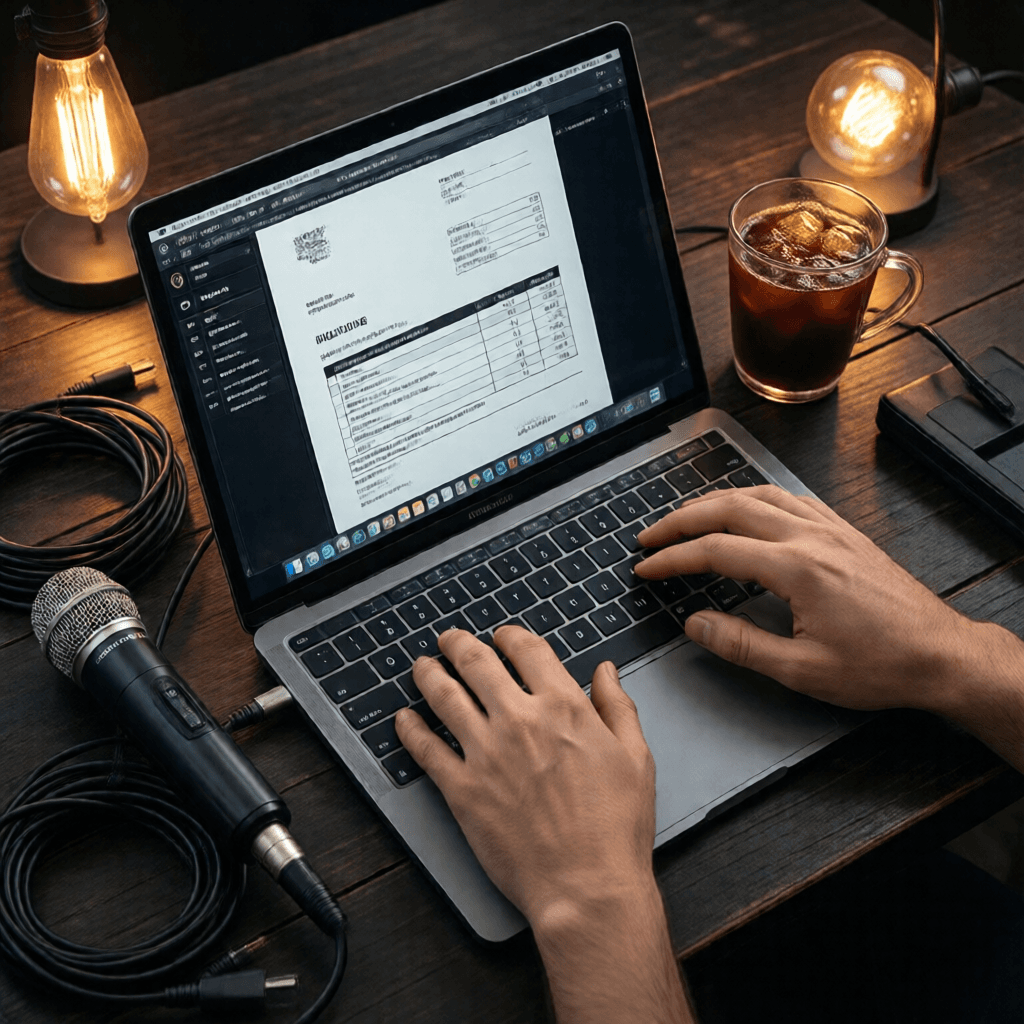
Most DJs price their gigs confidently, then hand over a Word document reading "DJ Services — $800" and wonder why clients push back on overtime or dispute the travel charge. The invoice is where gigs get paid — or where the argument starts. A sharp DJ invoice template fixes that before the night even begins.
- Your event fee belongs on its own line — never buried in a vague "services" total.
- Deposit paid must appear as a dated deduction, not a verbal reminder.
- Cancellation terms go on every invoice footer — clients reference the invoice on event day, not the original contract.
What Goes on a DJ Invoice (and What Most DJs Miss)
Generic invoice templates are built for desk-work freelancers who bill by the hour. They don't account for gear hauling, overtime clauses, or a deposit collected three months before the gig. Eight line items. Every one a non-negotiable.

Miss any one and you're either eating a cost or having an uncomfortable conversation at 11 PM when the father of the bride asks about a charge he didn't expect.
- Flat event rate or hourly performance fee — your core charge, listed first
- Equipment rental / gear surcharge — if the client is renting your sound system or lighting rig separately from your performance fee
- Travel fee — mileage or a flat rate for gigs beyond your set radius
- Setup / breakdown labor — the hour before and after that most clients never factor in
- Overtime rate — charged per 30-minute block beyond your contracted end time
- Deposit paid — clearly deducted from the total, with the date collected
- Remaining balance due — the actual number owed after deposit
- Cancellation fee clause — spelled out in the invoice footer, not tucked away in a separate contract
Here's what a clean 4-hour wedding gig looks like when you break it down properly:
| Line Item | Description | Amount |
|---|---|---|
| Event Performance Fee | Wedding reception — 4 hrs, Sat June 14, 2026 — Rosewood Venue | $850.00 |
| Equipment Rental | 2× PA speakers + subwoofer + lighting rig | $200.00 |
| Travel Fee | Round trip, 45 miles from home base | $65.00 |
| Setup / Breakdown | 1.5 hrs setup + 1 hr breakdown @ $50/hr | $125.00 |
| Subtotal | $1,240.00 | |
| Deposit Paid — March 10, 2026 | 50% deposit collected at booking | −$620.00 |
| Balance Due | $620.00 |
Every charge has a description — not just a dollar amount. Clients question what they don't understand. Itemization kills the question before it's asked. That's the difference between a professional invoice and a vague demand for money.
Flat Rate vs. Hourly: Which Structure to Use on Your Invoice
Wedding and private event DJs almost always price by the package — a flat rate covering contracted hours. Club and residency gigs run hourly. The structure changes how you lay out the invoice.

Flat rate: One line item. Include the event date, venue name, and contracted hours in the description field. Don't write "DJ Services." Write "Wedding reception performance — 5 hrs, July 19, 2026 — The Maison Ballroom." That description is your protection if a dispute ever surfaces.
Hourly: Show the calculation — "$150/hr × 4 hrs = $600." Add gear and production fees as separate line items below. Clients can verify the math themselves, which means fewer calls from clients who feel surprised.
Overtime gets its own line item. Every time. Roll it into the base rate and you're setting up an argument at midnight. List "Overtime — 1 × 30-min block @ $75" as a discrete charge and the rate is visible before the event starts. Nothing to dispute.
Wedding DJs who itemize overtime rates on their invoice collect those charges far more consistently than DJs who handle it verbally. When the rate is in writing before the event, there's nothing to argue about after it.
Here's what the difference looks like in practice:
- Event Fee — 5 hrs, July 19 — $900
- Equipment Rental — $150
- Travel Fee — $60
- Overtime — 1 × 30 min @ $75 — $75
- Deposit Paid June 1 — −$450
- Balance Due — $735
- DJ Services — $1,185
- Less deposit — −$450
- Total — $735
- (Client has no idea what they're paying for)
Both invoices total the same. Only one gets paid without a phone call. How you structure invoice payment terms around event dates and deposit schedules matters just as much — worth reading before your next invoice goes out.
Deposit and Cancellation Terms: Protect Your Booking
This is the section most DJs skip. It's also the most expensive section to get wrong.
"The invoice IS the contract for most solo DJs. If your cancellation terms aren't on it, you don't have cancellation terms."
Your deposit line needs three things: the amount, a clear label ("Deposit Paid — [Date]"), and a deduction from the subtotal. Don't just write "deposit." Include the date it was collected — that date is your paper trail if a client later disputes the timeline of their payment commitment.
Collect the deposit at booking. An uncollected deposit is a cancellation waiting to happen — with no compensation for you when it does.

For cancellation language, add a footer line directly on the invoice: "50% of remaining balance is due if this booking is cancelled within 30 days of the event date." Clients read the invoice the week of the event. They do not re-read the contract from six months ago. If your cancellation policy only lives there, it effectively doesn't exist when it matters most.
That's especially true if you're operating as a solo contractor without a formal business entity — the invoice is your primary legal document for the transaction. Treat it like one.
Put your cancellation policy on every invoice — not just in the initial contract. One line in the footer can save you hundreds of dollars and one very uncomfortable post-event conversation.
Don't skip late fee clauses either. If the remaining balance is due seven days before the event, a stated late fee keeps clients on schedule without the awkward follow-up text.
Eight line items: event fee, equipment rental, travel, setup/breakdown, overtime, deposit paid, remaining balance, and a cancellation clause in the footer. Generic templates skip the last three. Those three are where most DJ payment disputes happen. Build them in from the start and you'll spend far less time chasing money after the night is over.
Frequently Asked Questions
Should a DJ invoice include a contract or are they separate?
For solo and freelance DJs, the invoice often doubles as the booking agreement. Include your event date, venue, contracted hours, deposit amount, remaining balance, and cancellation terms directly on the invoice. If you have a separate contract, reference its number on the invoice so both documents are clearly linked.
How should a DJ invoice a wedding vs. a club night?
Wedding invoices use a flat event rate with itemized add-ons — equipment, travel, overtime. Club and residency invoices are hourly: list your rate, hours worked, and any production or gear fees as separate line items. Both formats should show deposit paid and balance due clearly.
Use Invoicito's free invoice generator to create a professional DJ invoice with all eight line items — event fee, deposit, overtime, cancellation terms, and everything in between.
Generate Your Free DJ Invoice →When should a DJ send an invoice — before or after the event?
Send two invoices: a deposit invoice at booking (typically 25–50% of the total fee) and a final invoice 7–14 days before the event showing the deposit credited and balance due. Sending the final invoice after the event puts you in a weaker position if the client disputes the amount or delays payment.
What cancellation terms should a DJ include on an invoice?
A standard DJ cancellation policy tiers the penalty by how far out the cancellation happens — deposit non-refundable at any point, 50% of remaining balance if cancelled within 60 days, 100% if cancelled within 30 days. State the policy in plain language in the invoice footer rather than just referencing a separate document the client may never re-read.