Lawn Care Invoice Template — Free for Independent Lawn Care and Yard Service Businesses
Free lawn care invoice template for independent mowing and yard service businesses. Covers per-visit billing, seasonal packages, equipment fees, and no-show policies.

You mow 14 lawns a week. Invoicing still takes longer than the actual work. That's a template problem — generic invoices weren't built for lawn care. They're missing the billing cycle, the service address, and any clear policy for locked gates and no-shows.
A proper lawn care invoice template fixes all three. Here's exactly what goes on yours.
- Lawn care invoices need a service property address, not just a billing address — the lawn location is your record.
- Choose per-visit or monthly billing based on how regular your client is.
- Always list a no-show fee — clients accept it on paper far better than as a surprise charge.
- Follow the 7-step fill-out guide below and build a complete invoice in under 2 minutes.
- Use Invoicito's free invoice generator — no signup, no friction.
What Goes on a Lawn Care Invoice (That's Different From Other Service Invoices)
Most service invoices need a client name and a dollar amount. Lawn care needs more — and the differences matter when you're billing the same client across 30-plus visits a year.

The critical one: service address vs. billing address. Your client might pay from a home office while the lawn is at a rental property across town. Always list the address where the work actually happened. That's your evidence if a dispute surfaces six months later.
Lawn care also carries line items you won't see on a plumber's bill. Here's a typical setup:
| Service | Frequency | Unit Price | Qty | Total |
|---|---|---|---|---|
| Mowing & edging | Weekly | $45.00 | 4 | $180.00 |
| Blowing (paths + driveway) | Weekly | $10.00 | 4 | $40.00 |
| Aeration (seasonal) | Once | $120.00 | 1 | $120.00 |
| Fuel surcharge (remote property) | Monthly | $15.00 | 1 | $15.00 |
| Total Due | $355.00 | |||
This looks nothing like a landscaping invoice, which tracks design work, plant installation, and project milestones — typically billed in phases or as a flat project fee. Lawn care is high-frequency and lower-ticket per visit. Billing cycle clarity is everything. Know what to put on an invoice before you send your first one.
Per-Visit vs. Monthly Billing: Which Model to Use
Both work. The right choice depends on your client's schedule — and your tolerance for admin.

Per-visit invoicing means sending an invoice after each job. Best for one-off clients, irregular requests, or new accounts without a locked-in schedule. The downside is overhead — 14 lawns a week is 14 separate invoices going out.
Monthly flat-rate invoicing bundles all weekly visits into one invoice at month's end. Cleaner to manage. Your client knows what's coming, and you spend 20 minutes on billing instead of two hours.
Clients on monthly billing pay faster than those invoiced per-visit. The payment feels expected rather than surprising — and expected invoices get processed first. For recurring clients, a consistent monthly due date is the fastest path to reliable cash flow.
Then there are no-shows. Locked gates, dogs in the yard, a client who forgot to leave access. Don't absorb that cost. Add a "Missed Appointment Fee" line — typically 50% of the visit price — and note the policy in your invoice footer. Clients who read the policy upfront accept it. Clients who see it for the first time on a charge dispute it every time.
"A transparent surcharge reads as professional. A mysteriously high total reads as sketchy."
— The principle behind every itemized lawn care invoice
Pair your no-show policy with firm invoice payment terms — Net 7 is standard for recurring lawn care, Net 15 if you're billing monthly. The recurring invoice strategy guide covers how service businesses structure predictable billing; most of it applies directly to lawn care.
How to Fill Out Your Lawn Care Invoice (Step by Step)
Marcus runs 18 lawn care accounts solo out of Austin. He was burning 30 minutes per invoice chasing down which address was which and manually tallying seasonal add-ons. A proper template cut that to under 5 minutes per client. Here's the exact sequence:
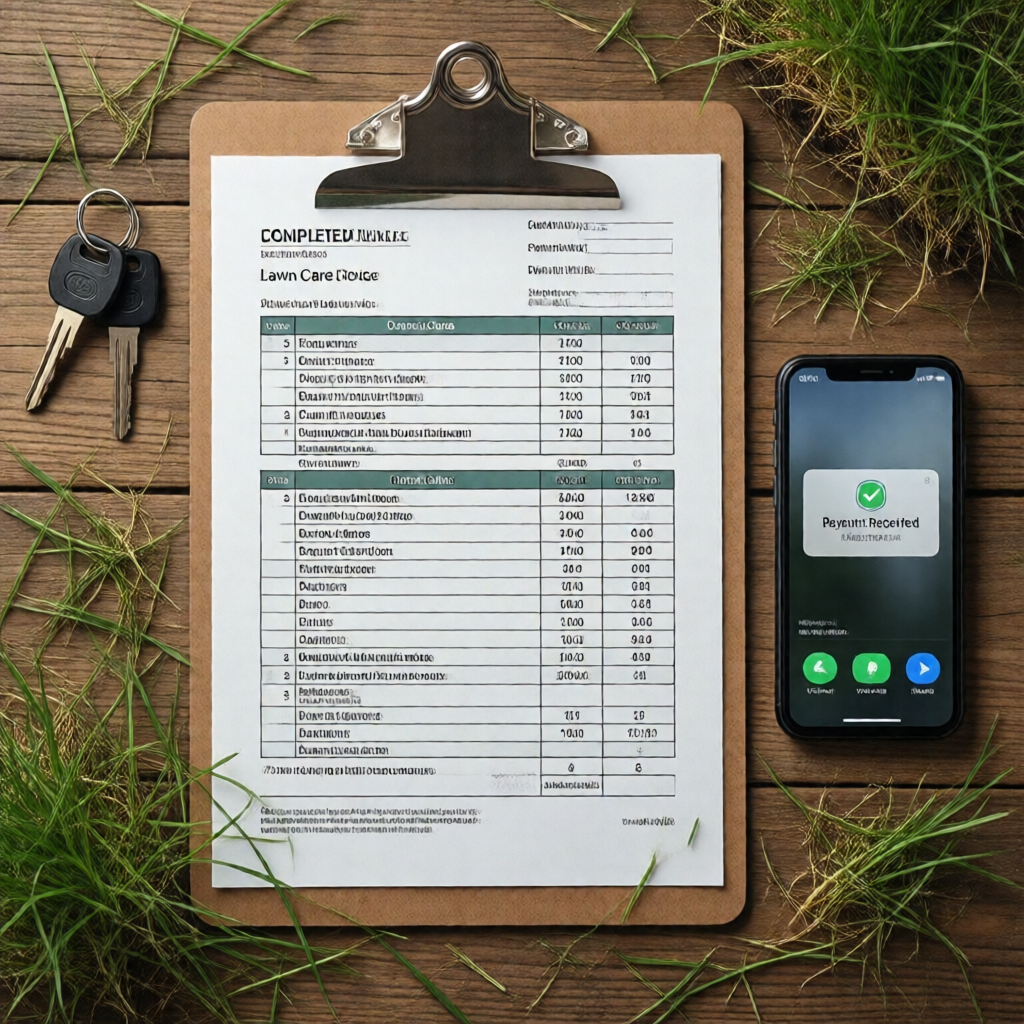
-
1
Your business name, phone, and email. Even if your client has your number, the invoice is a legal record. Make it complete.
-
2
Client name + service property address. Not billing address — the actual lawn location. This is your evidence of which property was serviced if a dispute surfaces months later.
-
3
Invoice number, invoice date, and due date. Sequential numbering (INV-001, INV-002) makes it easy to reference in follow-up emails and track what's outstanding at a glance.
-
4
Line items: mowing, edging, blowing, any extras. Be specific. "Mowing — 4 visits @ $45" beats "Monthly lawn service" every time. Clients who see itemized work pay faster and dispute less.
-
5
Equipment or fuel surcharge as its own line. Don't bury it in the base rate. A transparent surcharge reads as professional; a mysteriously high total reads as sketchy.
-
6
Payment terms + late fee notice. "Due within 7 days. A 1.5% monthly late fee applies after the due date." One sentence does the job. See how to add a late fee on an invoice if you're unsure how to word it.
-
7
A short thank-you note. "Thanks for trusting us with your yard — see you next week." Ten seconds to write. Makes you the operator clients actually keep.
If payment doesn't arrive after the due date, send a firm follow-up. An unpaid invoice reminder email — polite, direct, citing the invoice number and due date — moves most stragglers within 48 hours.
A lawn care invoice isn't just a payment request — it's a service record for every property you maintain. Get the address right. Pick a billing model and commit. Put your no-show fee in writing before the first visit. Most billing disputes trace back to things nobody wrote down. Write them down.
Frequently Asked Questions
Should I invoice per visit or send one monthly lawn care invoice?
Monthly invoicing wins for weekly recurring clients — it cuts admin time and clients expect it. Per-visit suits one-off or irregular jobs. Either way, state the billing cycle on the invoice so there's no confusion about when charges land.
How do I charge for a no-show on a lawn care invoice?
Add a "Missed Appointment Fee" line — typically 50% of the visit price. Note the policy in your invoice footer so clients see it before any dispute arises. If the charge gets ignored, a direct unpaid invoice reminder email usually resolves it fast.
What's the difference between a lawn care invoice and a landscaping invoice?
Lawn care covers recurring maintenance — mowing, edging, blowing, seasonal treatments — billed per visit or monthly. Landscaping covers design and installation projects, billed by milestone or hourly rate. Different work, different billing structures. Full breakdown at the landscaping invoice template.
Do I need a separate invoice for seasonal add-ons like aeration?
No — add it as its own line item on your regular invoice. Label it clearly ("Spring Aeration — one-time") so the client doesn't assume it recurs. One invoice for everything is cleaner for both your records and theirs.
Your time is worth protecting. A clear, professional invoice signals that you run a real operation — and real operations get paid on time.
Ready to build your lawn care invoice?
Fill one out in under 2 minutes — no signup, no templates to download.
Create Your Free Lawn Care Invoice →The Bottom Line
A lawn care invoice isn't paperwork — it's your best tool for getting paid on time, every time. The businesses that invoice consistently, clearly, and professionally collect faster and lose fewer clients to billing disputes.
- Itemize every service so clients see the value, not just the total
- Set Net 7 or Net 14 terms — the longer you wait to ask, the longer you wait to collect
- Include late fees and cancellation policies in the footer before disputes happen
- Use a free generator so invoicing takes minutes, not your Saturday morning