Free Makeup Artist Invoice Template — for Freelance MUAs and Mobile Beauty Professionals
Download a free makeup artist invoice template built for freelance MUAs. Covers bridal packages, kit fees, travel surcharges, deposits, and cancellation policies.

You just wrapped a bridal party of five — four hours, flawless work, genuinely happy client. Then you sent a one-line invoice: "Makeup services — $650." The bride questions the kit charge. No breakdown. No paper trail. Zero leverage in that conversation.
That's exactly what a proper makeup artist invoice template prevents. It isn't just a bill — it documents every service, locks in your deposit terms, and places your cancellation policy in front of the client before the booking, not after the dispute.
- Every service needs its own line item — bridal, editorial, SFX, and prom billed separately, never lumped together.
- Kit fee and travel surcharge are the most forgotten lines — skipping them costs MUAs hundreds every year.
- Put your cancellation policy on the invoice, not buried in a separate contract email.
- Per-look pricing makes deposit math simple — the cleaner choice for wedding bookings.
- Download the free template — pre-filled MUA line items, no account required.
What Every Makeup Artist Invoice Should Actually Include
The most common MUA invoicing mistake: a single "makeup services" total with no breakdown. That's a dispute waiting to happen. Each service — bridal application, editorial, special effects, airbrush, prom — earns its own line item with quantity, rate, and total. No exceptions.

Your invoice should flow in this order: service lines first, then add-on fees, then any deposit already collected, then the balance due. Here's what a clean MUA invoice looks like in practice:
- Bridal Application (1 look) — $175.00
- Bridesmaid Application (3 looks @ $95) — $285.00
- Airbrush Upgrade — $50.00
- Kit/Supply Fee — $35.00
- Travel Surcharge (22 miles @ $0.70/mile) — $15.40
- Bridal Deposit Paid (50%) — –$280.20
- Balance Due — $280.20
Travel surcharges can be billed per mile (the 2026 IRS standard mileage rate is $0.70/mile for business use), as a flat zone fee, or as a minimum booking requirement past a set distance. Pick one model, state it on every invoice, and stop renegotiating it in text threads.
Kit fee and travel surcharge are the two most commonly forgotten invoice lines. A modest $35 kit fee plus a $15 travel line across three bookings a week adds up to roughly $2,500 a year — revenue MUAs routinely sign away without realizing it.
Take Jess, a mobile MUA in Atlanta — she ran 15–20 bookings a month with zero kit or travel lines. Once she added both to a proper template, her average invoice value jumped nearly $50. Same work. Better paperwork.
The Cancellation Policy Belongs on the Invoice — Not Just Your Contract
A cancellation clause buried in a separate PDF is easy to miss and even easier for clients to claim they never received. When it appears directly on the invoice as a visible policy block, the client sees it, receives it, and can't credibly say otherwise.
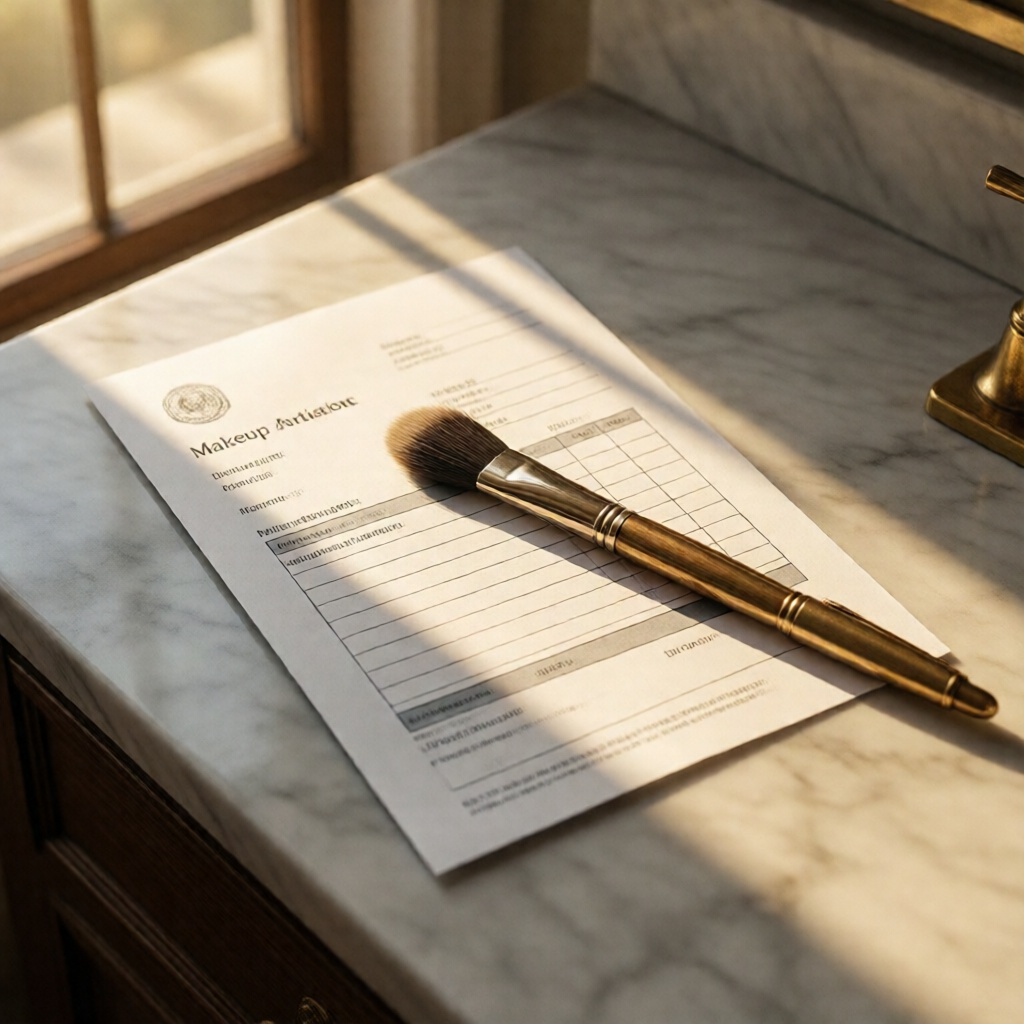
You don't need complex legal language. You need clarity. Plain wording like this covers most MUAs:
"Cancellation within 48 hours of the booking date: 50% of the total balance is retained as a rebooking fee. Cancellation within 24 hours: 100% of the total balance is due."
Add this as a labeled footer block on every invoice. Pair it with explicit invoice payment terms — deposit due on booking confirmation, balance due day-of — and you've eliminated the two most common dispute points in a single document.
For wedding bookings, the deposit line and cancellation policy work together. The deposit holds the date. The policy explains what happens to it when the bride's plans change two days out.
Hourly vs. Per-Look: Which Belongs on Your Invoice?
Both models work. The real question is which one a client can understand at 11pm before a 6am call time.
- Weddings and bridal parties
- Prom and event groups
- Bookings with a known headcount
- Deposit billing (easy 50/50 split)
- Clean, unambiguous invoice lines
- Editorial and BTS shoots
- Long filming days (TV, film, ad sets)
- Touch-up retainer bookings
- Agency jobs with variable call times
- When scope is genuinely open-ended
Per-look wins for most client-facing work. Full stop. A vague hourly estimate on a wedding invoice invites questions you don't want to field on a bride's wedding morning.
"Bridal party (4 looks) @ $95/look = $380" takes ten seconds to understand and five seconds to calculate a 50% deposit from. That's the invoice line you want.
Per-look also makes deposit math trivial: 50% of $380 is a $190 deposit line, clearly stated, no back-and-forth. If you're still working out how to structure billing rates, this guide on invoicing without underselling your work is worth reading before your next rate conversation.
Get the Free Template — Fill Online or Download as PDF

The free makeup artist invoice template on Invoicito is pre-built with all the lines above: service rows, kit fee, travel surcharge, deposit field, balance due, and a cancellation policy block at the bottom. Fill it online and download as PDF, or grab the blank and customize it in your own tools — no account required either way.
If you're invoicing multiple times a week, freelance invoice software is the natural next step — saved line items, automatic payment reminders, and a live view of what's paid versus outstanding. The template is the right starting point. Software is the upgrade when volume demands it.
A professional MUA invoice is your paper trail for deposits, kit fees, travel charges, and cancellation terms. Get every service on its own line, write your policy in plain language, and use per-look pricing for weddings. The disputes stop when the documentation is airtight.
Frequently Asked Questions
Should I include a deposit on my makeup artist invoice?
Yes — always, especially for weddings. A deposit line ("Bridal Deposit — 50% — $190") should appear on the initial invoice with the balance due date clearly stated alongside your payment terms. This documents when the deposit was collected, what it covers, and exactly what the client still owes. No ambiguity. No "I thought it was included" conversations.
What is a kit fee and how do I add it to an invoice?
A kit fee is a flat charge — typically $25–$75 — covering the consumables you use on a client: foundations, single-use applicators, brushes, sanitation supplies. Add it as its own labeled line item ("Kit/Supply Fee — $35.00") after your service lines. Some MUAs charge it as a percentage of the booking; a flat fee is simpler to explain and easier for clients to accept without pushback.
Can I add a cancellation policy directly on my invoice?
Yes — and it's smarter than relying on a separate contract the client may never re-read. A clearly labeled cancellation block at the bottom of your invoice means the client encounters it every time they view the document. Keep it plain and specific: cancellation window, percentage retained, whether the deposit is refundable. No legal jargon required.
Your work is skilled, your time is finite, and your bookings have real costs behind them. Your invoice should reflect all three.